
Rediscovering Traditional Wisdom: Back to Roots
Introduction – Traditional Bilona Ghee Benefits
In an era driven by speed, scale, and convenience, the way our food is produced has undergone a dramatic transformation. Industrial processing, mass production, and chemical interventions have made food more accessible—but often at the cost of traditional practices, authenticity, and the connection between food and its preparation. Against this backdrop, a powerful shift is taking place: a return to traditional Indian food preparation methods rooted in Ayurveda.
These time-tested practices are not just about cooking—they are about preserving traditional knowledge, enhancing the appreciation of natural ingredients, and aligning food preparation with practices followed for generations. Products like A2 Bilona Desi Ghee represent this philosophy through traditional methods of preparation. The traditional Bilona ghee benefits are closely associated with its time-honoured preparation process, including curd-based preparation and traditional churning.
Rather than being simply manufactured at scale, traditionally prepared ghee is carefully crafted through a deliberate process. Understanding the traditional Bilona ghee benefits allows consumers to appreciate not only the final product but also the traditional methods, craftsmanship, and dairy heritage behind it.
The Core Philosophy of Traditional Indian Food Preparation
Traditional Indian methods are deeply connected to Ayurveda, a 5,000-year-old system of natural healing. According to Ayurveda, food is not just fuel—it is medicine. The way food is prepared directly impacts its nutritional quality, digestibility, and effect on the body.
Modern industrial methods prioritize:
- Speed
- Shelf life
- Cost reduction
Whereas traditional methods focus on:
- Nutrient preservation
- Natural processing
- Digestive compatibility
- Seasonal and local sourcing
This fundamental difference is why traditionally prepared foods are increasingly valued today.
Traditional Bilona Ghee: A Benchmark of Purity
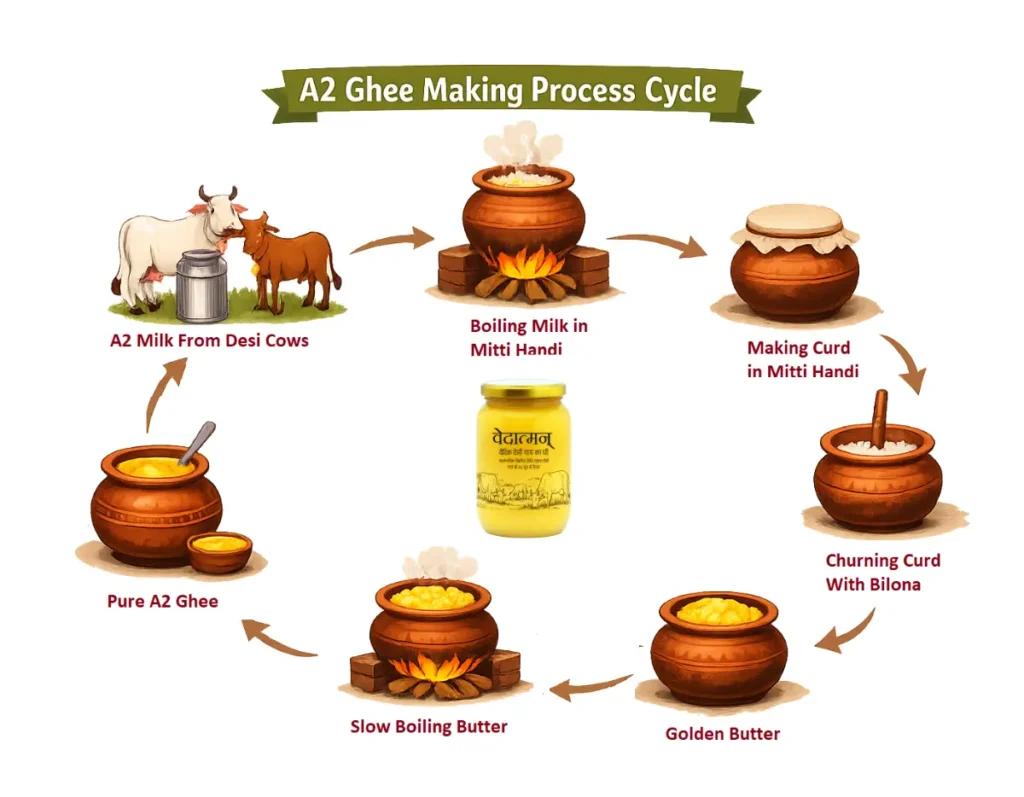
One of the finest examples of Ayurvedic preparation is A2 Bilona Desi Ghee. Unlike industrial ghee made from cream, Bilona ghee follows a multi-step, time-intensive process:
Step-by-Step Traditional Process:
- Fresh A2 milk from desi cows is boiled
- It is naturally converted into curd
- The curd is hand-churned using a wooden bilona
- Butter (makkhan) is extracted
- Butter is slowly heated to produce ghee
- Cost reduction
This process typically takes 24–48 hours, compared to a few hours in factory methods.
Why Traditional Methods Are Superior
Superior Nutrient Retention
Traditional preparation avoids high-speed processing and excessive heat. Slow cooking and natural fermentation ensure that:
- Fat-soluble vitamins (A, D, E, K) are preserved
- Essential fatty acids remain intact
- Natural enzymes are retained
In contrast, industrial refining often strips away these nutrients.
Enhanced Digestibility
One of the key principles of Ayurveda is “Agni” (digestive fire). Traditional foods are designed to support digestion, not burden it.
- Bilona ghee made from curd contains short-chain fatty acids, which are easier to digest
- Fermentation improves gut health
- Natural processing reduces toxin formation
This is why traditionally made ghee is often recommended even for people with sensitive digestion.
Rich Flavor and Authentic Aroma
Taste is not just a sensory experience—it’s a marker of quality. Traditional Bilona ghee benefits are also reflected in its distinctive sensory qualities. The slow and traditional preparation process can contribute to a deep, nutty aroma and rich flavour, allowing the natural character of the ghee to stand out without the need for artificial flavouring.
Industrial methods often compromise on taste due to rapid processing and chemical refining.
No Chemicals, No Compromise
Traditional methods rely on:
- Natural fermentation
- Manual processes
- Low heat
There is no need for:
- Preservatives
- Additives
- Chemical refining agents
This ensures a clean-label product, which is increasingly important for health-conscious consumers.
Higher Input Cost, Genuine Output
One of the biggest reasons traditional products are priced higher is the input-output ratio.
- 25–30 litres of A2 milk are required to make just 1 litre of ghee
- Desi cows produce only 6–7 litres/day, compared to 18–30 litres by hybrid breeds
Additionally:
- The entire milk is used in the process
- There are no by-products (like skim milk or cream) to sell separately and recover cost
In industrial methods:
- Cream is separated
- Remaining milk is sold
- Cost is distributed across multiple products
This is not possible in the Bilona method, making it inherently more expensive—but also more authentic.
Labor-Intensive Craftsmanship
Traditional ghee is not made by machines alone—it involves human effort at every stage:
- Manual churning (bilona)
- Careful monitoring of temperature
- Small-batch handling
This increases:
- Production time
- Labor cost
- Attention to detail
But also ensures:
- Quality consistency
- Authentic preparation
Small Batch, Farm-Level Production
Unlike factory-made ghee produced in bulk, traditional ghee is:
- Made in small batches
- Produced at farm level
- Closely monitored for quality
This limits scalability but enhances:
- Freshness
- Traceability
- Purity
Alignment with Ayurvedic Principles
Ayurveda emphasizes:
- Sattvic food (pure, balanced)
- Seasonal consumption
- Natural processing
Bilona ghee is considered:
- Tridosha balancing (balances Vata, Pitta, Kapha)
- Supportive for immunity and vitality
Traditional mustard oil is valued for:
- Warming properties
- Circulation support
Traditional bilona ghee benefits are closely tied to how the food is prepared—not just what it is.
Environmental Sustainability
Traditional methods are inherently sustainable:
- Support local dairy farmers
- Reduce reliance on industrial machinery
- Use low-energy processes
- Promote indigenous cow breeds
Cold-pressed oil extraction often uses:
- Wooden churners (kolhu/ghani)
- Minimal electricity
This results in:
- Lower carbon footprint
- Eco-friendly production
Cultural and Emotional Value
Food is deeply connected to culture. Traditional preparation methods:
- Preserve generational knowledge
- Strengthen connection to roots
- Reflect authenticity and trust
For many families, Bilona ghee is not just a product—it’s a legacy.
Traditional vs Industrial: The Real Difference
Factor | Traditional Bilona Method | Industrial Method |
Raw Material | A2 milk | Cream / mixed milk |
Process | Curd → Churning → Butter → Ghee | Direct cream heating |
Time | 2-3 days | Few hours |
Output Efficiency | Low | High |
By-products | None commercially significant | Skim milk sold |
Additives | None | Possible |
Scale | Small batch | Mass produced |
Nutrition | High retention | Highly reduced |
Why This Matters for Today’s Consumer
Modern consumers are becoming more aware of:
- Food sourcing
- Ingredient quality
- Processing methods
There is a clear shift toward:
- Clean-label products
- Traditional foods
- Authentic nutrition
This is not a trend—it’s a correction. People are realizing that cheaper food often comes at a hidden cost:
- Lower nutrition
- Chemical exposure
- Long-term health impact
The True Cost of Authenticity
When evaluating the price of A2 Bilona ghee, it’s important to understand – You are not just paying for a product, you are paying for:
- High-quality A2 milk
- Low-yield indigenous cows
- Time-intensive preparation
- Skilled manual labor
- Zero shortcuts
- Authentic Ayurvedic process
In essence, you are paying for purity, not production efficiency.
Conclusion: Back to Roots, Forward to Health
The resurgence of traditional Indian food preparation methods reflects a deeper shift in consumer mindset—from convenience to consciousness. People are increasingly interested in understanding how their food is sourced, prepared, and brought to their kitchens.
The traditional Bilona ghee benefits are an important part of this renewed interest in time-tested Indian dairy practices. Consumers are looking beyond the finished product and paying greater attention to the traditional methods, ingredients, and craftsmanship involved in its preparation.
Traditional Bilona ghee is made through a deliberate process involving curd, traditional churning, and gradual preparation. Understanding these methods helps consumers appreciate the traditional Bilona ghee benefits while making more informed choices about the food they bring into their kitchens.
This growing awareness encourages people to look beyond labels and understand the traditions, processes, and choices that shape the food they consume. A2 Bilona Desi Ghee and cold-pressed mustard oil are not just premium products—they are symbols of:
- Nutritional integrity
- Cultural continuity
- Sustainable living
As more people rediscover these methods, the focus is no longer on “why it costs more”, but on “why it is worth more.” Returning to traditional wisdom is not about going backward—it’s about making better choices for the future.
Discover traditionally prepared Vedatman A2 Ghee, crafted in small batches using the traditional Bilona method and inspired by India’s rich dairy heritage. Explore the Vedatman range and choose the pack that best suits your needs.
References:
- Varuni SJ, Sathe K.
Critical analysis of Goghrita (cow ghee) and its action on Rasa Dhatu.
Journal of Ayurveda and Integrative Medical Sciences.