
How Much Milk Is Required to Make 1 Litre of Ghee?
Have you ever wondered how much milk is required to make 1 litre of ghee?
For traditionally prepared Bilona ghee, approximately 25–30 litres of milk may be required to produce around 1 litre of ghee. However, this is an approximate figure rather than a fixed formula. The final yield depends on factors such as milk-fat content, milk composition, butter recovery and processing efficiency.
To understand why a relatively large quantity of milk results in a much smaller quantity of ghee, it helps to look at the complete traditional process.
The Short Answer
The traditional Bilona process may require approximately 25–30 litres of milk to produce around 1 litre of ghee.
This does not mean that every 25 or 30 litres of milk will always produce exactly 1 litre. Milk composition varies, and so does the efficiency of the different stages involved in making ghee.
The amount of milk fat available for recovery is particularly important.
Why Does It Take So Much Milk to Make Ghee?
Milk contains much more than fat. It consists primarily of water along with milk fat, proteins, lactose, minerals and other components.
Ghee, on the other hand, is highly concentrated milk fat. During the traditional process, much of the water and non-fat components are separated from the fat.
The transformation takes place gradually:
Milk → Curd → Butter → Ghee
First, the milk is converted into curd. The curd is then churned to obtain butter. Finally, the butter is slowly heated to remove moisture and separate the remaining milk solids.
What remains is clarified milk fat — ghee.
This is why the quantity of finished ghee is considerably smaller than the original quantity of milk.
What Happens to the Milk During the Bilona Process?
The traditional Bilona method involves several stages.
1. Milk
Fresh milk is the starting point.
Its composition, particularly its fat content, has a direct influence on the potential ghee yield.
2. Curd
The milk is allowed to set and ferment into curd.
This curd-based approach is an important part of the traditional Bilona method.
3. Churning
The curd is traditionally churned to separate butter.
The amount of butter recovered depends on the fat available in the curd and the effectiveness of the churning and separation process.
4. Slow Heating
The butter is slowly heated.
Moisture is removed and the non-fat milk solids separate from the milk fat.
5. Ghee
The clarified fat that remains is filtered to obtain the finished ghee.
The complete journey can therefore be summarized as:
Fresh Milk → Curd → Bilona Churning → Butter → Slow Heating → Ghee
What Determines Ghee Yield?
There isn’t one fixed milk-to-ghee conversion that applies to every batch. Several factors influence the final yield.
Milk-Fat Content
Milk-fat content is one of the most important factors.
Since ghee is predominantly milk fat, milk containing more fat has greater potential to produce butter and ultimately ghee.
This is why two batches containing the same volume of milk can produce different quantities of ghee.
Butter Recovery
Not all of the available fat necessarily ends up in the collected butter.
The effectiveness of churning and butter separation influences how much fat is recovered and carried forward to the next stage.
Milk Composition
Milk is a natural product and its composition can vary.
Breed, feed, lactation stage and individual animal characteristics can all influence milk composition.
As a result, the amount of milk needed to produce a particular quantity of ghee can vary between batches.
Processing Losses
Small losses can occur during curd handling, churning, butter collection, heating, filtration and transfer.
These losses can influence the final quantity of finished ghee.
Indigenous Cow Milk and Ghee Yield
The type of cow also influences the milk available for traditional ghee production.
Indigenous Indian cow breeds generally produce less milk per animal than high-yielding crossbred or exotic dairy cattle. This means that obtaining a substantial quantity of milk from indigenous cows can require more animals, time or milk collection compared with high-yielding dairy breeds.
However, milk-fat content is not determined by the broad category of “indigenous” or “hybrid” alone. It can vary considerably by breed, individual animal, feed, lactation stage and other factors.
Therefore, it would be inaccurate to say that every indigenous cow produces milk with either higher or lower fat than every crossbred cow.
For ghee production, what matters is the amount of milk fat available and how efficiently it is recovered.
This is one reason why milk volume alone does not tell the complete story behind ghee yield.
Why Milk Fat Is More Important Than Milk Volume
Consider two batches, each containing 25 litres of milk.
If one contains more milk fat than the other, the two batches do not have the same potential ghee yield.
A useful way to understand the process is:
Available milk fat → Butter recovery → Clarification → Finished ghee
The quantity of milk matters, but its composition matters just as much.
Is 25–30 Litres a Fixed Rule?
No.
The 25–30 litre figure is an approximate production range, including the quantity used in Vedatman’s traditional process.
It should not be interpreted as a universal formula applicable to every producer or every batch.
Actual yield can vary depending on:
- Milk-fat percentage
- Milk composition
- Breed
- Butter recovery
- Churning efficiency
- Moisture content
- Processing losses
Therefore, saying that exactly 25 litres of milk will always produce exactly 1 litre of ghee would oversimplify the process.
Why Is Traditional Bilona Ghee More Involved to Produce?
The traditional Bilona route requires several stages before the finished product is obtained.
Rather than simply processing separated cream, the process involves preparing curd, churning it to obtain butter and then slowly clarifying that butter.
This involves additional:
- Time
- Labour
- Handling
- Processing stages
- Raw material
The milk requirement is therefore only one part of the overall production effort.
Why Is Bilona Ghee More Expensive?
The cost of traditionally prepared Bilona ghee is influenced by more than the price of milk.
The production process may involve:
- Milk procurement
- Curd preparation
- Traditional churning
- Butter collection
- Slow heating
- Labour
- Small-batch production
- Laboratory testing
- Packaging
- Storage and transportation
When a relatively large quantity of milk is required to produce a smaller quantity of finished ghee, the raw-material requirement naturally becomes an important part of the production cost.
The additional time and labour involved in the traditional process also contribute to the overall cost.
For a deeper explanation, this topic can be covered separately in a dedicated article on why Bilona ghee is expensive.
How Much Milk Does Vedatman Use for 1 Litre of Ghee?
Vedatman’s traditional Bilona process uses approximately 25–30 litres of milk to prepare 1 litre of ghee.
The process follows:
Fresh Milk → Curd → Bilona Churning → Butter → Slow Heating → Ghee
Vedatman produces the ghee in small batches and independently laboratory tests the finished product.
You can see the complete traditional process here:
Traditional Bilona Process of Making Cow Desi Ghee
What Should You Check Before Buying Traditionally Made Ghee?
The quantity of milk used is useful information, but it should not be the only factor you consider when choosing ghee.
Look at the complete picture:
Production Method
Check whether the producer clearly explains how the ghee is made and whether the process follows the traditional curd-to-butter-to-ghee route.
Ingredients
Look for clear ingredient information and avoid products that contain unnecessary additives.
Testing
Independent laboratory testing can provide additional information about the quality and characteristics of the finished product.
Transparency
A trustworthy producer should be willing to explain the source of the milk, production process and testing rather than relying only on broad marketing claims.
Manufacturing Information
Look for relevant regulatory and manufacturing information, including FSSAI details where applicable.
The aim should not be to judge a ghee by one claim alone. Consider the raw material, process, testing and transparency together.
Frequently Asked Questions
How much milk is required to make 1 litre of ghee?
Approximately 25–30 litres of milk may be required for around 1 litre of traditionally prepared Bilona ghee. The actual quantity can vary according to milk-fat content, milk composition and processing efficiency.
Does 25 litres of milk always produce 1 litre of ghee?
No. The 25–30 litre figure is an approximate range. Actual yield can differ between batches depending on milk composition and the efficiency of butter recovery and processing.
Does higher-fat milk produce more ghee?
Generally, milk with higher fat content has greater potential to produce more ghee because ghee is predominantly milk fat. However, actual yield also depends on how efficiently the fat is recovered during processing.
Why does Bilona ghee require so much milk?
Milk contains a large proportion of water and other non-fat components. During the traditional process, milk is converted into curd, curd is churned into butter, and butter is clarified into ghee. Only a fraction of the original milk ultimately becomes finished ghee.
Does indigenous cow milk affect ghee yield?
Yes. Indigenous breeds generally have lower milk yields than high-yielding crossbred or exotic dairy cattle. However, milk-fat content varies by breed and individual animal, so yield cannot be determined from breed category alone.
Why is Bilona ghee more expensive?
Traditional Bilona production can require more raw material, time, labour and processing stages. Curd preparation, churning, butter recovery, slow heating, testing and small-batch production can all contribute to the final cost.
Is the milk-to-ghee ratio the same for every producer?
No. The yield varies according to milk composition, fat content, production method and processing efficiency.
Final Takeaway
So, how much milk is required to make 1 litre of ghee?
For traditional Bilona production, approximately 25–30 litres of milk may be used to prepare around 1 litre of ghee.
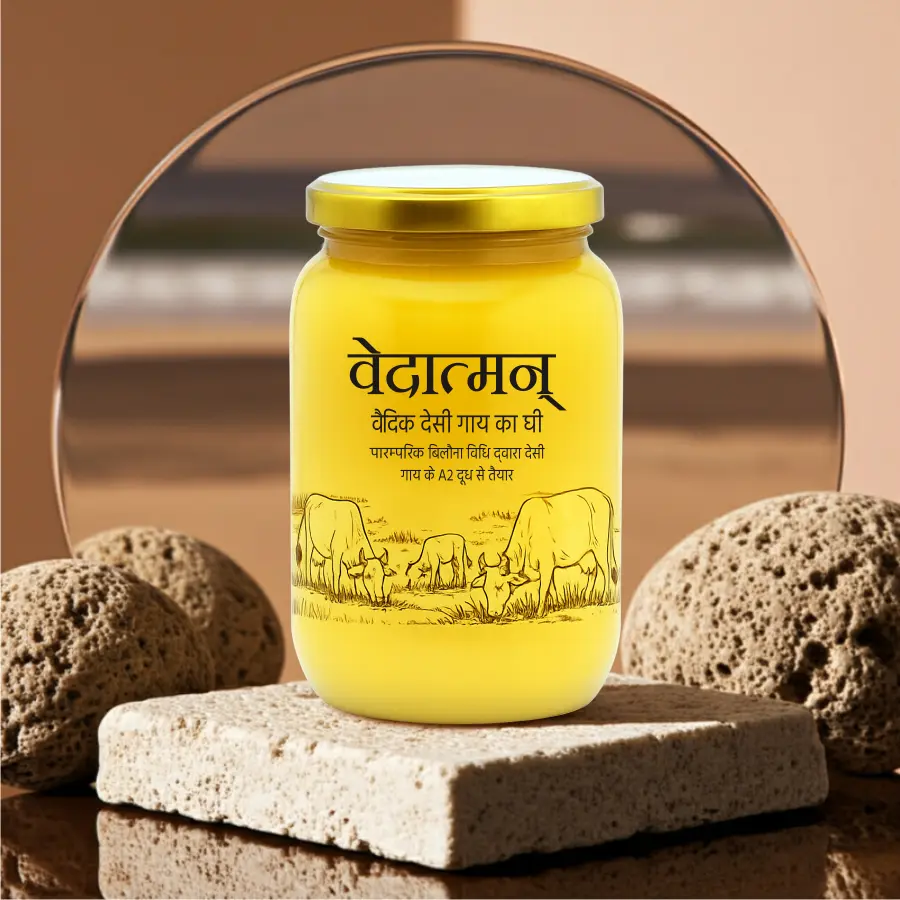
Vedatman A2 Cow Desi Ghee
Vedatman A2 Cow Desi Ghee – 1 Litre
Traditional Bilona ghee made from curd, produced in small batches & independently laboratory tested.
The exact yield is not fixed. Milk composition, milk-fat content, breed, butter recovery and processing efficiency can all influence the final quantity.
The simplest way to understand the traditional process is:
Milk → Curd → Butter → Slow Heating → Ghee
The relatively small quantity of finished ghee compared with the original milk is a result of concentrating the available milk fat through these stages.
Understanding this process provides useful context for the raw material, time and craftsmanship involved in traditionally prepared Bilona ghee.
External References
- Food Safety and Standards Authority of India (FSSAI): https://www.fssai.gov.in
- National Dairy Development Board (NDDB): https://www.nddb.coop
- National Institute of Nutrition (India): https://www.nin.res.in
- Food and Agriculture Organization (FAO): https://www.fao.org