
Wooden Bilona vs Machine Processing: What Changes in Traditional Ghee Making?
When people buy ghee today, they often focus on the final product. However, the method used to prepare ghee can be just as important as the ingredients themselves. This is why the discussion around Wooden Bilona vs Machine Processing has become increasingly relevant among consumers seeking authenticity, transparency, and traditional food preparation methods.
While both methods produce ghee, they represent two very different philosophies of production. One follows a centuries-old tradition rooted in Indian dairy heritage, while the other is designed to maximize speed, efficiency, and large-scale output.
Understanding the differences between Wooden Bilona vs Machine Processing can help consumers make informed decisions and appreciate what goes into every jar of traditionally prepared ghee.
Understanding the Traditional Bilona Method
The Traditional Bilona Method is one of India’s oldest dairy preparation techniques. For generations, Indian households prepared ghee through a process that began with fresh milk rather than industrial cream separation.
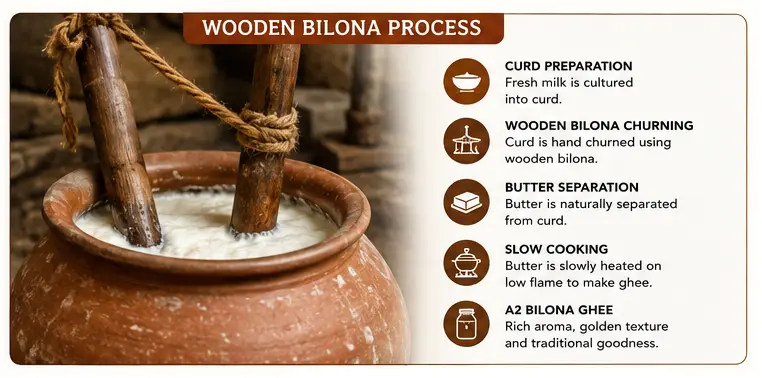
The journey starts by converting milk into curd. The curd is then churned using a wooden churner known as a Bilona. Through this process, butter is naturally separated from the curd. The butter is then slowly heated to prepare ghee.
Unlike modern industrial systems, every stage of the process requires time, attention, and human involvement. The focus is not on producing the highest volume possible but on following a method that has been passed down through generations.
This traditional approach is one of the reasons why many consumers continue to seek out authentic Bilona ghee today.
What is Machine Processing?
Machine processing refers to modern industrial methods used to manufacture dairy products on a large scale.

In large production facilities, milk is often collected from multiple sources and transported to centralized processing units. Advanced machinery separates cream, processes large volumes, and produces ghee at a much faster rate than traditional methods.
Industrial production offers significant advantages in terms of scalability and efficiency. It allows manufacturers to supply large markets and maintain consistent production throughout the year.
However, the priorities of industrial production differ considerably from those of the traditional Bilona process.
Wooden Bilona vs Machine Processing
One of the most visible differences in the Wooden Bilona vs Machine Processing comparison is the churning process itself.
Traditional Wooden Bilona Churning
In the traditional system, curd is churned using a wooden Bilona. The process is gradual and often carried out in small batches. The churning helps separate butter naturally from the curd.
This method reflects traditional Indian dairy practices and requires significant manual effort.
Mechanical Churning
Industrial facilities use machinery capable of processing large quantities in a short period of time. The objective is efficiency, consistency, and high-volume production.
While machines offer speed and operational advantages, they eliminate much of the manual involvement and traditional craftsmanship associated with the Bilona method.
Milk Traceability: A Major Difference
One of the most overlooked aspects of the Wooden Bilona vs Machine Processing debate is milk traceability.
Consumers today increasingly want to know:
- Where the milk comes from
- Which cows (indegenous A2 cows or Mixed Cows) produced the milk
- How the animals are cared for
- How the milk was processed
Traceability in Traditional Bilona Production
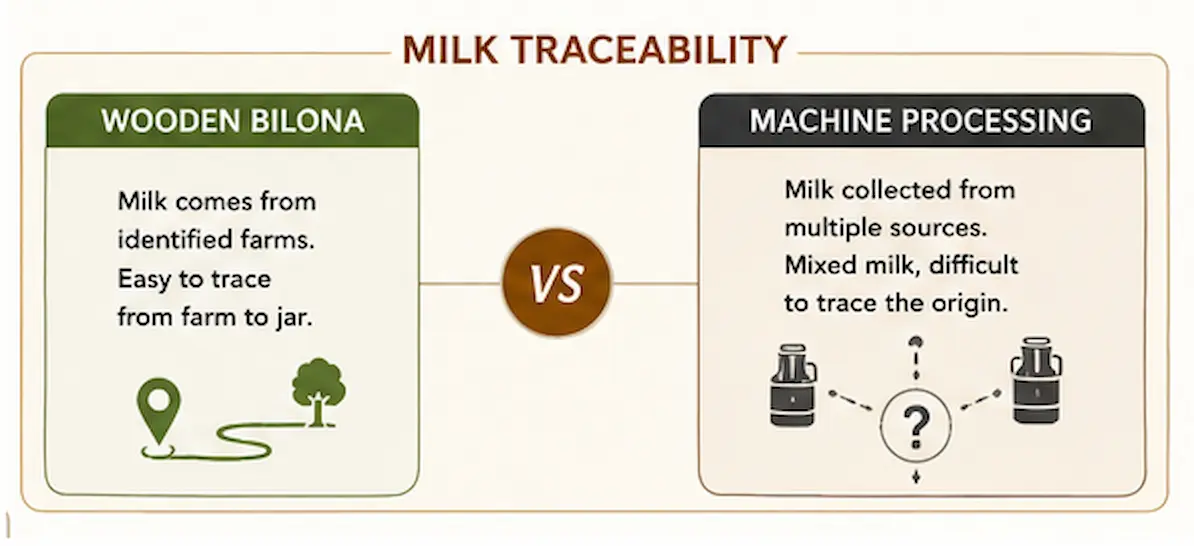
Traditional Bilona producers often work with a smaller network of farms or their own dairy operations. Because the scale is smaller, it is generally easier to trace the source of the milk used in production.
Consumers can often learn more about:
- Cow breeds
- Feeding practices
- Farm conditions
- Production methods
This transparency helps build trust and confidence.
Traceability Challenges in Industrial Production
Industrial production systems require large quantities of milk every day. To meet demand, milk is often collected from numerous collection centers and multiple suppliers before being pooled together.
While this system efficiently supports large-scale production, consumers may find it difficult to determine the exact source of milk used in a particular batch of ghee.
As awareness around food sourcing grows, many consumers increasingly value products that provide greater visibility into the journey from farm to jar.
Curd-Based Bilona Process vs Cream-Based Production
Another important difference lies in the starting ingredient.
Traditional Bilona Process
The Traditional Bilona Process begins with milk that is converted into curd. The curd is then churned to obtain butter before ghee is prepared.
This approach follows the method traditionally used in Indian households for generations.
Industrial Cream-Based Production
Many industrial systems separate cream directly from milk and use that cream as the primary raw material for ghee production.
This approach significantly improves efficiency and production speed but differs fundamentally from the traditional curd-based Bilona process.
For consumers seeking authentic Bilona ghee, this distinction is often considered an important part of the product’s identity.
How Processing Temperature Can Affect Aroma
One of the most appreciated characteristics of traditionally prepared ghee is its rich aroma.
The aroma of ghee develops through a complex interaction of milk fats and naturally occurring compounds during preparation.
Slow Preparation in Bilona Ghee
Traditional Bilona producers generally heat butter gradually and in smaller batches. The slower process allows the aroma to develop over time and contributes to the distinctive sensory experience associated with handcrafted ghee.
High-Volume Industrial Production
Industrial production environments are optimized for efficiency and throughput. Depending on the manufacturing process, cream handling and production may involve higher temperatures and faster processing cycles.
Many consumers believe that slower traditional preparation better preserves the natural aroma, flavor complexity, and handcrafted character that they expect from authentic Bilona ghee.
Small-Batch Craftsmanship vs Mass Production
The difference between Bilona Ghee vs Machine Made Ghee extends beyond equipment.
It is also a comparison between small-batch craftsmanship and mass production.
Small-Batch Bilona Production
Traditional Bilona preparation typically focuses on smaller quantities.
Benefits include:
- Greater attention to detail
- Better production oversight
- Improved transparency
- Easier quality monitoring
- Preservation of traditional methods
Large-Scale Industrial Production
Industrial facilities are designed to maximize output.
Benefits include:
- High production capacity
- Standardized manufacturing
- Broad market availability
- Operational efficiency
However, the emphasis is often on scale rather than traditional craftsmanship.
Why More Consumers Are Choosing Authentic Bilona Ghee
The growing popularity of Authentic Bilona Ghee reflects broader changes in consumer preferences.
Today’s consumers increasingly value:
- Transparency
- Traditional preparation methods
- Traceable sourcing
- Heritage foods
- Small-batch craftsmanship
- Authentic production practices
Rather than focusing solely on the final product, many consumers want to understand the entire production journey.

This shift has encouraged renewed interest in the traditional Bilona method and the values it represents.
How Vedatman Preserves Traditional Bilona Practices
At Vedatman, the focus remains on preserving traditional Indian dairy craftsmanship through a curd-based Bilona process.
The preparation emphasizes:
- Traditional curd formation
- Wooden Bilona churning
- Small-batch production
- Slow preparation methods
- Transparent sourcing practices
This approach reflects a commitment to maintaining the authenticity and heritage of traditional Indian ghee-making.
Frequently Asked Questions
What is Wooden Bilona Churning?
Wooden Bilona churning is a traditional method of separating butter from curd using a wooden churner.
Why is the Bilona method considered traditional?
The Bilona method has been used in Indian households and rural dairy systems for generations and follows a curd-based preparation process.
What is the difference between Bilona ghee and machine-made ghee?
Traditional Bilona ghee is generally prepared from curd using wooden churning, while machine-made ghee is often produced through large-scale industrial processes.
Why is milk traceability important?
Traceability helps consumers understand where the milk originates and how it was produced before becoming ghee.
Why do many consumers prefer traditional Bilona ghee?
Many consumers appreciate the transparency, small-batch craftsmanship, traditional preparation methods, and heritage associated with authentic Bilona ghee.
Conclusion
The comparison between Wooden Bilona vs Machine Processing is about much more than technology.
It reflects two different approaches to food production. One prioritizes speed, efficiency, and scale. The other emphasizes tradition, transparency, traceability, and craftsmanship.
As more consumers seek authentic foods with a clear connection to their origins, the traditional Bilona method continues to gain appreciation for preserving the heritage and values of traditional Indian dairy preparation.
Explore Traditionally Prepared A2 Bilona Ghee
Experience the difference of a traditional curd-based Bilona process inspired by generations of Indian dairy craftsmanship.
✔ Traditional Wooden Bilona Churning
✔ Small-Batch Preparation
✔ Greater Transparency
✔ Authentic Traditional Process
Hope, by the end of this explanation, the difference between Wooden Bilona vs Machine Processing is clearly understood. Explore Vedatman’s collection of traditionally prepared A2 Bilona Ghee.